The Weird Kid Always Gets the Callback
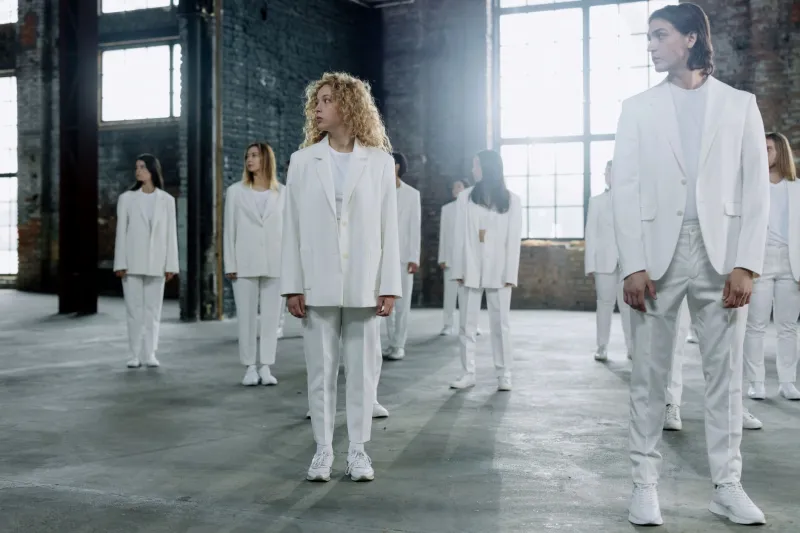
You know the feeling. You walk into a room full of performers who all seem to have gotten some instruction manual you never received. They look a certain way, move a certain way, have a certain polish that reads as industry-standard. And you stand there thinking — not for the first time — that you might be in the wrong room.
Here's what I want to tell you: stay in the room. And stop trying to look like everyone else in it.
The Mold Was Made for Someone Else
Every era of entertainment has its dominant type — the look, the sound, the vibe that casts directors seem to be endlessly chasing. And every era also eventually gets bored of itself and starts reaching for something it hasn't seen before.
The performers who get remembered — the ones who build careers that actually last — are almost never the ones who perfected the template. They're the ones who brought something the template couldn't account for. The unexpected quality. The specific strangeness. The presence that doesn't quite fit the category but is absolutely impossible to ignore.
Think about the performers who genuinely changed something in you as an audience member. Were they the most conventionally polished people in the room? Or were they the ones with something unnameable going on — a quality that felt irreducibly theirs?
That quality has a name. It's called distinctiveness. And it cannot be manufactured.
The Specific Problems of Being Different
I want to be real here, because the "your weirdness is your superpower" narrative can feel dismissive of what it actually costs to not fit the mold in this industry.
If you're navigating an unconventional appearance, an age that doesn't fit the ingénue or leading-man bracket, a background that's outside the mainstream, an accent that reads as regional, a body that doesn't match the chorus line expectation, or an identity that the industry has historically been slow to center — the challenges are real and specific. Doors close that shouldn't. Feedback is coded and sometimes cruel. The gap between "interesting" and "bookable" can feel impossibly wide.
None of that is your imagination. The industry has structural biases that are genuinely worth naming.
And also — this is the both/and part — your difference is an asset. Not in a way that erases the difficulty, but in a way that creates opportunities unavailable to the people who fit the standard mold. Because the market for "standard" is saturated. The market for genuinely distinctive is always hungry.
Owning It vs. Hiding It
There's a version of navigating difference that involves strategic concealment — downplaying the accent, adjusting your presentation to read more mainstream, softening the edges that make casting directors uncomfortable. Sometimes this works tactically, and I'm not going to pretend the calculation isn't real.
But there's a long-term cost to that approach. When you spend your energy managing how you're perceived rather than deepening what you bring, you become a less interesting version of yourself. You get better at disappearing into the background. And the background doesn't get callbacks.
Owning your difference looks different. It means walking into the room with the full version of yourself — the accent, the energy, the specific way you inhabit a character that doesn't look like what everyone else is doing. It means learning to articulate what makes you distinctive rather than apologizing for it. It means auditioning for rooms that actually want what you have, instead of exhausting yourself trying to fit rooms that don't.
This requires a level of self-knowledge that takes time to develop. But the performers who figure it out become genuinely difficult to replace.
Finding the Rooms That Want You
Not every room is your room. That's not a failure — it's information.
One of the most practical things you can do as a performer who doesn't fit the standard mold is get strategic about where you're directing your energy. This means researching the creative teams behind projects you admire and noticing patterns — which directors consistently cast outside the conventional type, which production companies actively seek nontraditional voices, which platforms are building audiences specifically hungry for the kind of story only you can tell.
The independent film world, new play development, devised theater, web series, and digital content creation have historically been more hospitable to performers who don't fit the mainstream template. These aren't consolation prizes. Some of the most creatively vital work being made right now is happening in exactly these spaces, and it's reaching audiences that the traditional industry hasn't figured out how to reach.
You might also consider creating your own room. The performers who've turned unconventional backgrounds and identities into full creative careers are increasingly the ones who stopped waiting to be cast and started building their own projects. The tools to do this — cameras, editing software, distribution platforms — are more accessible than they've ever been. Your story, told in your voice, is not a niche product. It's an underserved market.
The Thing Nobody Else Can Do
Here's the core of it: there is something you do that nobody else does exactly the way you do it. Not because you're the most technically perfect, or the most classically trained, or the most conventionally attractive version of a performer — but because you are specifically, irreducibly you.
That specificity is not a quirk to be managed. It's the whole point.
The industry will tell you, sometimes loudly, that you need to fit the box. And there will be seasons where that pressure is real and the financial stakes make it hard to push back. But the performers who build careers that matter — careers with longevity and meaning and work they're actually proud of — are the ones who figured out how to make the industry want the box they come in.
Stop trying to be a better version of someone else's type. Start being the definitive version of yours.
That's the callback worth waiting for.