Why the Work You Do 'On the Side' Might Be Your Most Important Work
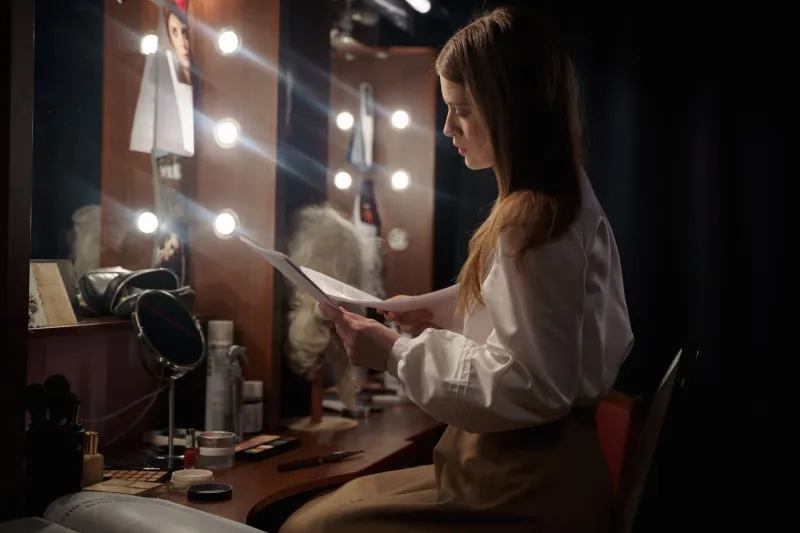
There's this story I keep coming back to about a Broadway understudy who spent her off-hours writing and performing her own one-woman show in a 40-seat black box theater in Brooklyn. Nobody told her to do it. Her agent definitely wasn't pushing for it. And by most industry metrics, it wasn't advancing her career in any measurable way.
Then the show got picked up. Then it transferred. Then the opportunities she'd been quietly grinding toward for a decade started arriving — not because she'd worked harder at the main thing, but because she'd refused to stop doing the other thing.
This isn't a rare story. It just doesn't get told enough.
The Psychological Weight of Putting All Your Eggs in One Basket
When your entire creative identity is tied to a single pursuit — one audition, one role, one deal — the stakes warp your relationship with the work itself. Desperation has a smell. Audiences pick up on it. Casting directors pick up on it. Even your own body picks up on it, tensing where it should be loose, pushing where it should be easy.
Having only one outlet means every rejection lands like a verdict on your entire self. Every slow season feels like the beginning of the end. That's not just emotionally exhausting — it's creatively limiting. You can't take interesting risks when you feel like you can't afford to fail.
But when you've got something else going — a podcast you love making, a screenplay you're chipping away at, a band that plays dive bars on weekends — the calculus changes. The main gig is still important, but it stops being everything. And that shift in psychological weight? It frees you up to actually be good at it.
Side Projects Aren't Backup Plans — They're Pressure Valves
Let's be clear about something: maintaining multiple creative outlets isn't about hedging your bets or preparing for failure. It's not the artistic equivalent of keeping your résumé updated just in case. It's about giving yourself room to breathe inside the work that matters most to you.
When performers talk about being "in their head" during a performance, what they're usually describing is the absence of flow — that hyper-aware, self-monitoring state where you're watching yourself instead of just doing. It's almost impossible to find flow when you're performing from a place of scarcity.
Side projects, passion work, creative experiments — these create a kind of psychological surplus. They remind you that you can make things, that you do have ideas, that your value isn't dependent on whether this particular thing works out. And that surplus shows up in your primary work whether you intend it to or not.
The Cross-Pollination Nobody Talks About
Here's the part that actually surprised me when I started paying attention to it: the skills and instincts you develop in your side work don't stay contained there. They bleed over.
A performer who writes learns how to think about structure and pacing in ways that transform their physical storytelling. Someone who directs — even community theater, even student films — develops a spatial and relational intelligence that makes them a completely different scene partner. A musician who takes up visual art starts thinking about negative space and rhythm in ways that reconfigure how they move through a room.
This isn't just theoretical. Research in creativity consistently points to the value of what psychologists call "conceptual combination" — the way ideas from different domains collide and generate novel solutions. The most innovative thinkers, across fields, tend to have wide-ranging interests. Not because they're scattered, but because they're building a richer internal vocabulary to draw from.
Your side project is secretly a laboratory. Every experiment you run there is data you get to use everywhere else.
Redefining What 'Serious' Looks Like
There's a version of "taking your craft seriously" that looks like total, singular devotion — one thing, all the time, no distractions. And I get the appeal of that narrative. It's clean. It's cinematic. It's also, for a lot of people, a fast track to burnout and creative rigidity.
The performers I've seen sustain genuinely interesting careers over the long haul almost always have a more expansive definition of their creative life. They're not just an actor or just a singer or just a dancer. They're a storyteller who happens to work primarily in one medium right now — but who stays curious, stays making, stays alive to the full range of what they're capable of.
That's not a lack of focus. That's a different kind of discipline.
So What Does This Actually Look Like in Practice?
It doesn't have to be elaborate. You don't need a second career or a fully realized side hustle with its own LLC and Instagram account (though hey, no judgment if that's where it goes).
It might look like:
- Keeping a creative journal where you write, draw, or collage with zero pressure toward any outcome
- Saying yes to the weird, low-budget short film because the concept genuinely excites you
- Starting a reading group with other performers around a playwright or author you love
- Learning an instrument badly and joyfully with no intention of performing it
- Developing a personal project you'd make even if nobody ever saw it
The through line is genuine interest. Not strategy. Not positioning. Just — this is something I actually want to explore.
Because when you find that thing, and you let yourself do it without it needing to be anything other than what it is, something interesting tends to happen. You bring that energy back to the main work. You show up less desperate and more curious. You start making bolder choices because you've remembered, in your bones, that making things is something you know how to do.
The Real Backup Plan
So maybe the understudy mentality isn't really about having a fallback. Maybe it's about understanding that creative vitality doesn't come from narrowing — it comes from staying wide open to the full range of what you're capable of.
The backup plan that's secretly your best plan isn't a safety net. It's a reminder of who you are when nobody's watching and nothing's on the line. And that version of you — relaxed, curious, genuinely engaged — is exactly who you want showing up to do the work that matters most.