Rejection Isn't Just in Your Head — It Lives in Your Body, Too
You've heard the advice a thousand times. Shake it off. Don't take it personally. Develop thicker skin. Move on to the next one. And you've probably tried. You've read the mindset books. You've journaled. You've done the affirmations. You've told yourself all the right things.
And then you get another no, and something in your chest just... drops. Your jaw tightens. Your shoulders go somewhere near your ears. You feel it before you've even consciously processed it.
That's not weakness. That's biology. And understanding it might be the most useful thing you do for your career this year.
What's Actually Happening When You Get Rejected
Let's start with some science, because it genuinely matters here.
Neuroscientists at UCLA conducted studies showing that social rejection activates the same regions of the brain as physical pain — specifically the dorsal anterior cingulate cortex and the anterior insula. These are the same areas that light up when you stub your toe or burn your hand. Your brain, at the neurological level, does not meaningfully distinguish between being told "we went another direction" and being physically hurt.
That's not metaphor. That's measurable brain activity.
For performers, this gets compounded in a specific way. Most people experience rejection occasionally — a job application, a social situation. Performers experience it as a core feature of their professional lives. Audition. Rejection. Audition. Rejection. Sometimes dozens of times a month. What happens when you repeatedly activate a pain response without adequate recovery time? The same thing that happens to any tissue under chronic stress: it starts to break down.
Your nervous system begins to operate in a near-constant low-grade threat state. Your body stays braced. And over time, that bracing becomes the default — a kind of full-body armor that you wear everywhere, including into the very auditions and performances where you need to be the most open and available.
The Physical Patterns Nobody Talks About
If you've been in this industry for any length of time, you might recognize some of these:
- Chronic tension in the jaw, neck, or shoulders that no amount of massage seems to fully resolve
- A tendency to hold your breath during high-stakes moments
- Difficulty fully dropping into emotional availability onstage, even when you know the material cold
- A body that feels "locked" or "braced" in audition rooms specifically
- Fatigue that feels disproportionate to what you've actually done
These aren't personality quirks or technical problems. They're physiological adaptations. Your body has learned that this environment — the audition room, the callback, the performance space — is where pain happens. And it's trying to protect you.
The problem is that the same protection that keeps you defended also keeps you from doing your best work. You can't be simultaneously armored and vulnerable. And vulnerability, as every serious acting teacher will tell you, is the whole game.
Why Willpower Isn't the Answer
Here's where the "just push through it" advice breaks down completely. Willpower operates in the prefrontal cortex — the thinking, reasoning, executive-function part of your brain. But the threat response lives in the limbic system, which is older, faster, and not particularly interested in your logical arguments.
You cannot think your way out of a nervous system response. You have to work with the body directly.
This is what somatic approaches — body-based practices — understand that purely cognitive strategies miss. If the wound is physical, the recovery has to be physical too.
Practices That Actually Help
This isn't about becoming someone who doesn't feel rejection. That's not the goal, and honestly, the people who don't feel it usually aren't doing work that matters to them. The goal is to build a body that can process rejection and return to baseline more efficiently — so the hits don't accumulate into something that permanently changes how you move through your work.
Regulated breathing as a daily practice, not just a crisis tool. Extended exhale breathing — where your out-breath is longer than your in-breath — directly activates the parasympathetic nervous system and signals safety to your body. Doing this for five to ten minutes every day, not just after hard news, builds genuine nervous system flexibility over time.
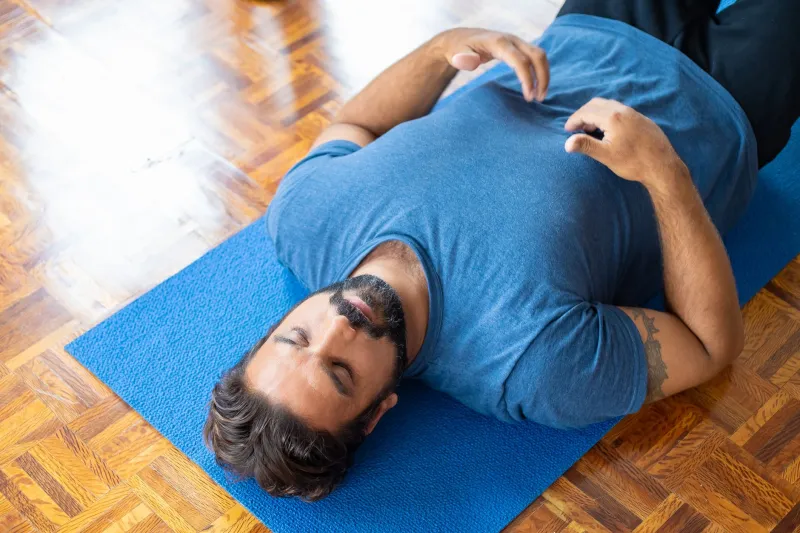
Movement that isn't performance. Yoga, swimming, walking, dancing in your kitchen — any movement that you do purely for sensation and not for outcome gives your body a space to discharge accumulated stress without the stakes of being evaluated. Your nervous system needs places where movement is safe and consequence-free.
Somatic tracking. After a rejection, before you do anything else, just notice where you feel it in your body. Not what you think about it — where you feel it. Jaw? Chest? Stomach? Naming the physical location of an emotion activates the prefrontal cortex and actually reduces the intensity of the limbic response. It's a small thing, but it works.
Cold water exposure. Brief cold showers or face immersion in cold water activates the dive reflex and rapidly downregulates the sympathetic nervous system. It sounds extreme, but the research is solid and the effect is real. Even thirty seconds of cold at the end of your shower makes a measurable difference in stress recovery.
Titrated exposure, not avoidance. Working with a therapist who uses somatic or trauma-informed approaches can help you gradually desensitize the threat response specifically around audition and performance contexts — not by forcing you through them, but by building capacity incrementally.
Building a Recovery Protocol
Think about how athletes approach physical recovery — with the same intentionality they bring to training. Ice baths. Nutrition timing. Sleep protocols. They don't just expect their bodies to bounce back; they actively create the conditions for recovery.
Performers need the same framework. What does your post-rejection protocol look like? Not your coping mechanism — your actual recovery protocol. The sequence of things you do to help your nervous system return to a state where you can create again.
For some people it's movement. For some it's time in nature. For some it's a specific kind of social connection. The content matters less than the intentionality. You are training your body to know that after the hit, there is a pathway back.
The Long Game
Building genuine resilience — the kind that doesn't require you to white-knuckle your way through every hard moment — takes time and it takes body-level work. But performers who invest in it don't just survive this industry longer. They stay more open, more available, and more creatively alive across the arc of their careers.
Your body has been keeping score. It's time to start working with that, instead of against it.